Prop Challenge
Know your distance to every rule before the next trade.
Most prop-firm challenges are not lost to a bad strategy. They are lost to a rule understood approximately — a daily loss measured on equity, a drawdown that trails the high-water mark, a trading day that resets at the firm's midnight. Sage evaluates your journaled trades against the rules you enter, exactly as you enter them, and reports the one thing that matters minutes before a trade: how much room is left. It never says "safe". It gives you the number.
In the app: Prop Challenge
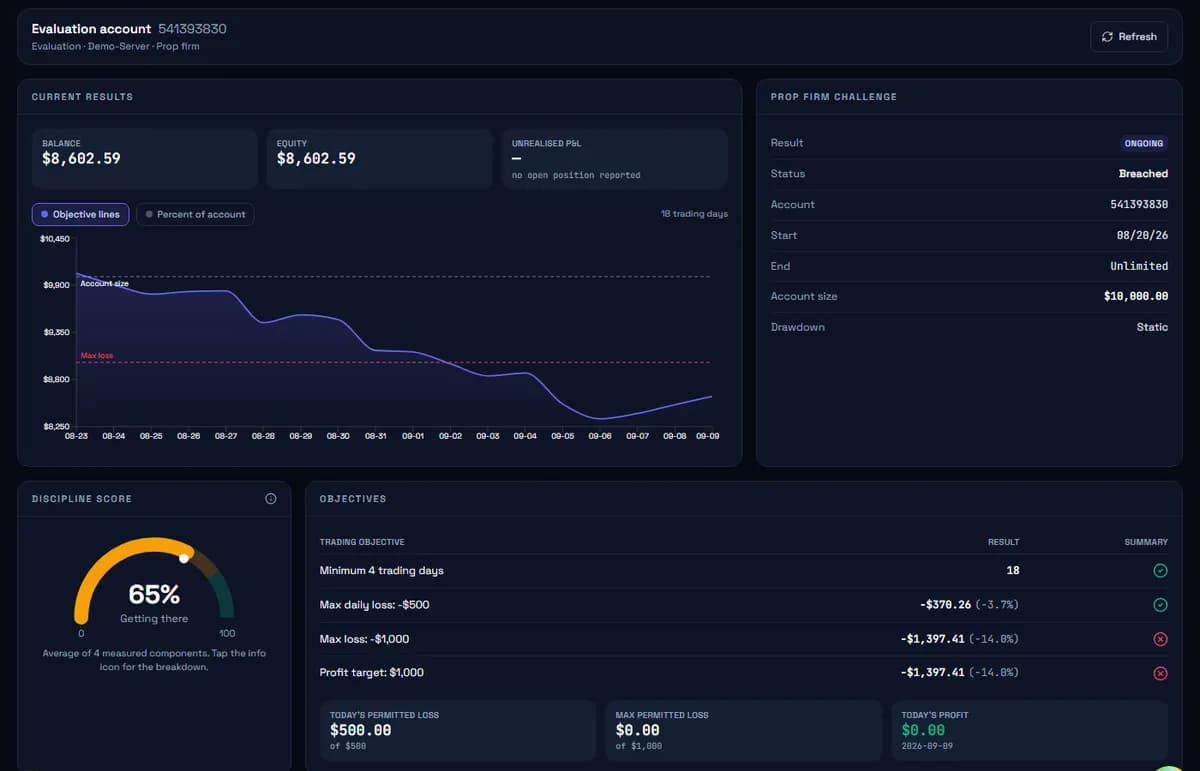
Shown with sample data.
What it is
Prop Firm Tracker, concretely.
As measured
The rules, as firms apply them
Daily loss as a percent of starting balance with the firm's UTC offset for the day reset; maximum loss either static (from the starting balance) or trailing (from the highest balance reached); a profit target; minimum trading days; a start date so earlier trades are ignored.
Distance
Room, in money
Gauges for today's loss and overall drawdown show used, limit and remaining — and a projection of how many average losers reach the daily limit from here.
Honest
Closed trades only, and it says so
Firms measure on equity, which includes open positions. This counts closed trades, so the reported loss is a floor, never a ceiling — the page states it rather than smoothing it over.
Account view
The metrics page a funded trader knows
Account overview, objectives with their status, an equity curve, per-day and per-trade results, and the breakdowns by session and weekday — the same shape as the dashboard the firm shows you, on your own data.
Memory
Every attempt, with its cause
Passed or failed, each attempt is kept with its rules, trades and the rule that ended it. Two failures for the same reason is a pattern, and patterns are fixable.
Rehearsal
Run a challenge in the backtester
Apply the same rules to a replay session: it locks on a breach and issues a certificate on a pass. Practise on historical data before paying for an evaluation.
How it works
How a trader actually uses it.
- 01
Enter the rules exactly as written
Account size, daily loss %, max loss % and whether it trails, target, minimum trading days, the firm's day offset from UTC, and the start date.
- 02
Journal as usual
Every closed trade updates the gauges. Sync from MetaTrader 5 and you type nothing.
- 03
Check the room before you size
Today's remaining and overall remaining, in money, next to the projection of how many losers it takes to breach. Size so a normal losing day cannot reach the daily line.
- 04
Keep the attempt, learn the cause
Whether the account passes or breaks, the attempt stays on record with the reason. Across attempts the behavioural pattern is usually obvious.
What it is, and isn't
Straight about the limits.
It does
- ✓Daily loss (with day offset), static or trailing max loss, profit target, minimum trading days, start date — the trader's own numbers
- ✓Distance to each limit, breach detection on the day it happened, a projection of losers-to-breach
- ✓Attempt history with cause of failure; the same rules inside backtest sessions with lock and certificate
- ✓Works for any firm's programme — you enter the percentages from your agreement
It doesn't
- ✕Connect to the firm or see your live equity — open positions are not counted, so the loss shown is a floor
- ✕Say "safe", or predict a pass
- ✕Ship any firm's current numbers — they change; read your agreement
- ✕Enforce anything at your broker; it informs the decision, it cannot take the mouse
Prop Firm Tracker, answered.
- Which prop firms does it support?
- Any. You enter the rules from your own agreement — the percentages, static or trailing drawdown, target, minimum days and the firm's day reset — so it works for FTMO-style evaluations and every other programme that publishes its limits.
- Does it count open positions?
- No. It evaluates closed trades, so today's loss is a floor on what the firm sees, not a ceiling. Leave room for open positions, and the page reminds you to.
- What is the difference between static and trailing drawdown?
- Static measures the maximum loss from the starting balance, so the floor never moves. Trailing measures it from the highest balance you have reached, so the floor rises with your profits — a good start can be given back and still end the challenge. Our guide explains both with examples.
- Can I practise a challenge before paying?
- Yes. A backtest session can run in prop-challenge mode with the same rules on the replay clock. It locks on a breach and issues a certificate on a pass.
- Is the tracker free?
- Yes, with the rest of the workspace.
Keep going
- Free toolProp-firm drawdown calculatorHow much room does today leave you? Enter the account size, daily-loss and max-loss rules, static or trailing drawdown, and your P&L so far to see the losses that would end the challenge.
- GuideProp-firm challenge rules, explained the way they are measuredHow prop-firm challenge rules are actually measured — daily loss on equity, static vs trailing drawdown, minimum trading days, server-time resets — and how to track your distance to each limit before the next trade.
- FeatureBacktesting & Market ReplayBacktest a discretionary strategy the honest way: a full TradingView workspace paused at your cursor, no lookahead on any of 16 timeframes, intrabar fills on the historical bid/ask spread, trades you place in the moment, and an exact R:R simulator. Free.
- FeatureRealistic BacktestingBacktest on the bid/ask spread quoted each minute, not one fixed guess: entries, exits, stop losses and take profits fill on the side of the book they trade on.
- FeatureTrading Psychology & DisciplineTrading psychology from your own data: automatic revenge-trade and tilt detection from timestamps and risk, a 30-second daily check-in with mood-versus-performance, and process goals verified against your trades — max trades per day, cooldown after a loss, risk under a limit, checklist on every entry.
- GuidePosition sizing: size the trade from the risk, never the other way roundThe one formula that decides your survival: units = money at risk ÷ stop distance. Worked examples for forex, gold and indices, why fixed-fractional beats fixed lots, and how sizing interacts with prop-firm limits.
- FeatureTrading JournalA free online trading journal for forex, gold, indices, futures and crypto. Log trades in seconds or auto-sync from MetaTrader 5, measure everything in R, tag by setup and session, attach screenshots, and see your year on a calendar. Your data stays yours.
See every module on the features overview.
Try prop firm tracker on your own trades.
Create your workspace in ten seconds. Everything on this page is free, with no card and no paid tier.
Free · no card · your data stays yours