Playbook
Your setups, written down — and then held to account.
A tag is a label; a play is a hypothesis. Sage's Playbook turns the ideas you trade into written plays — a thesis, structural rules for context, entry, confirmation, invalidation, exit and risk, where the play applies, how much it risks — each with a life the trader chooses: idea, testing, live, retired. Ideas are pre-registered: *I believe… I would be wrong if… how I will test it*, written before the data can answer. Then every backtest session and live trade links to a play, and the play accumulates its own tested and live record. There are no templates and no supplied vocabulary. An empty playbook is an invitation.
In the app: Playbook
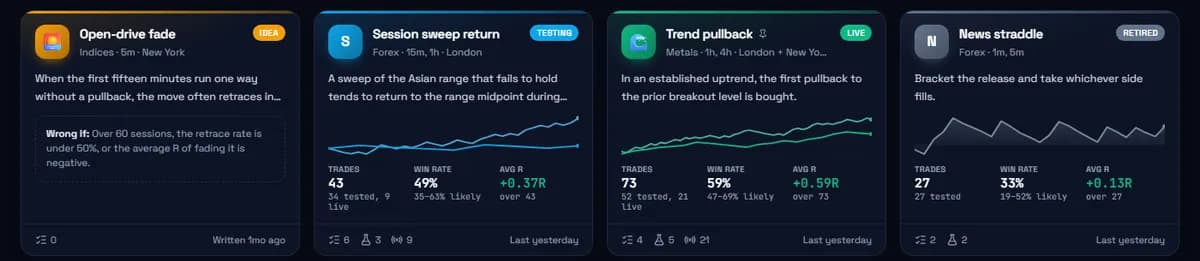
Shown with sample data.
What it is
Trading Playbook, concretely.
Pre-registered
The idea can fail, so it can pass
I believe / I would be wrong if / How I will test it — captured when the play is an idea, before any result exists. The research standard, applied to your own trading.
Structural
Rules in your words
Rule kinds are fixed — context, entry, confirmation, invalidation, exit, risk — but the rules themselves are yours. The product counts; it does not judge or suggest.
Connected
Sessions and trades hang from plays
Link a backtest session to the play it is testing, and a live trade to the play it belongs to — from the trade form, the guided Forge, or in bulk from the trades table.
Checked
Rules become the checklist
A play's rules are the pre-trade checklist for its sessions. Because checklist items are the rule ids, adherence is measured per rule: which rule you actually keep, and which you skip.
Two columns
Tested vs live
Each play shows its backtest record and its live record side by side — expectancy, win rate with intervals, sample size — so the hand-off from testing to live is a comparison, not a hope.
A life
Idea → testing → live → retired
The status is chosen by the trader, never derived. Retiring a play that stopped earning its place is discipline, and the progression system treats it as one.
How it works
How a trader actually uses it.
- 01
Write the play as an idea
Thesis, rules by kind, markets and sessions it applies to, risk. Pre-register how it could be wrong.
- 02
Test it in replay
Create a backtest session linked to the play. Its rules are the session's checklist; its trades build the tested record.
- 03
Take it live, small
Move it to live, link real trades to it, and watch the live column against the tested one — with the intervals telling you when a difference means something.
- 04
Keep, adjust, or retire
A play that keeps earning stays live. One whose live record diverges gets a new version or a retirement — recorded, not deleted, so the history stays honest.
What it is, and isn't
Straight about the limits.
It does
- ✓Plays with a thesis, six kinds of rules, applicability and risk; pre-registration of ideas; a trader-chosen lifecycle
- ✓Links from backtest sessions and live trades (single or bulk); rules as the session checklist with per-rule adherence
- ✓Tested-vs-live statistics with sample sizes and confidence intervals; a filter and column for plays in All Trades
- ✓Playbook achievements in the progression system — first play, pre-registration, going live, a real sample, retiring one
It doesn't
- ✕Supply templates, example setups or a strategy vocabulary — the plays are yours
- ✕Derive a play's status from results; you decide what is live and what is retired
- ✕Judge a play; it shows counts and intervals
- ✕Automate execution of a play's rules
Trading Playbook, answered.
- What is a trading playbook?
- A written collection of the setups you trade, each with its rules and its record. In Sage a play carries a thesis, rules by kind, where it applies, how much it risks, a lifecycle you control, and the tested and live statistics of every session and trade linked to it.
- Why pre-register an idea?
- Because an idea written down after seeing the results will fit the results. Stating in advance what would prove it wrong is the only way it can genuinely be proven right.
- How do plays relate to tags?
- Tags are free labels for anything. A play is a specific hypothesis with rules and a record. Use tags for conditions and behaviour; use plays for the setups you deliberately trade. Trades can carry both.
- Can I link old trades to a play?
- Yes — select any number of trades in the All Trades table and assign them to a play in one action.
Keep going
- FeatureBacktesting & Market ReplayBacktest a discretionary strategy the honest way: a full TradingView workspace paused at your cursor, no lookahead on any of 16 timeframes, intrabar fills on the historical bid/ask spread, trades you place in the moment, and an exact R:R simulator. Free.
- FeatureTrading JournalA free online trading journal for forex, gold, indices, futures and crypto. Log trades in seconds or auto-sync from MetaTrader 5, measure everything in R, tag by setup and session, attach screenshots, and see your year on a calendar. Your data stays yours.
- FeatureTrading Analytics & Edge AnalysisTrading performance analytics that read what your journal recorded: expectancy by setup, session and tag with confidence intervals, an exact R:R simulator on real 1-minute price paths, Sharpe, Sortino, SQN, Kelly, drawdown and Monte Carlo ruin probability. Free.
- GuideHow to backtest a trading strategy without fooling yourselfA step-by-step method for manual backtesting: write the rules first, replay candle by candle with no lookahead, keep an out-of-sample stretch, measure in R and know when the sample is big enough.
- GuideHow to find your trading edge — in your own trades, not someone else'sAn edge is a condition under which your results beat your own baseline by more than chance explains. How to slice trades by setup, session, tag and time of day, compare against the baseline with confidence intervals, and avoid the traps of small samples and many comparisons.
- FeatureTrader Progression & Gamified DevelopmentA gamified trading journal that rewards the right things: levels and XP from journaling, backtesting, analysis and kept discipline; daily and weekly missions; a skill tree across Research, Analyst, Discipline and Strategy; gold for themes, sidebar skins, card skins, badges and characters. Never for volume or risk.
See every module on the features overview.
Try trading playbook on your own trades.
Create your workspace in ten seconds. Everything on this page is free, with no card and no paid tier.
Free · no card · your data stays yours